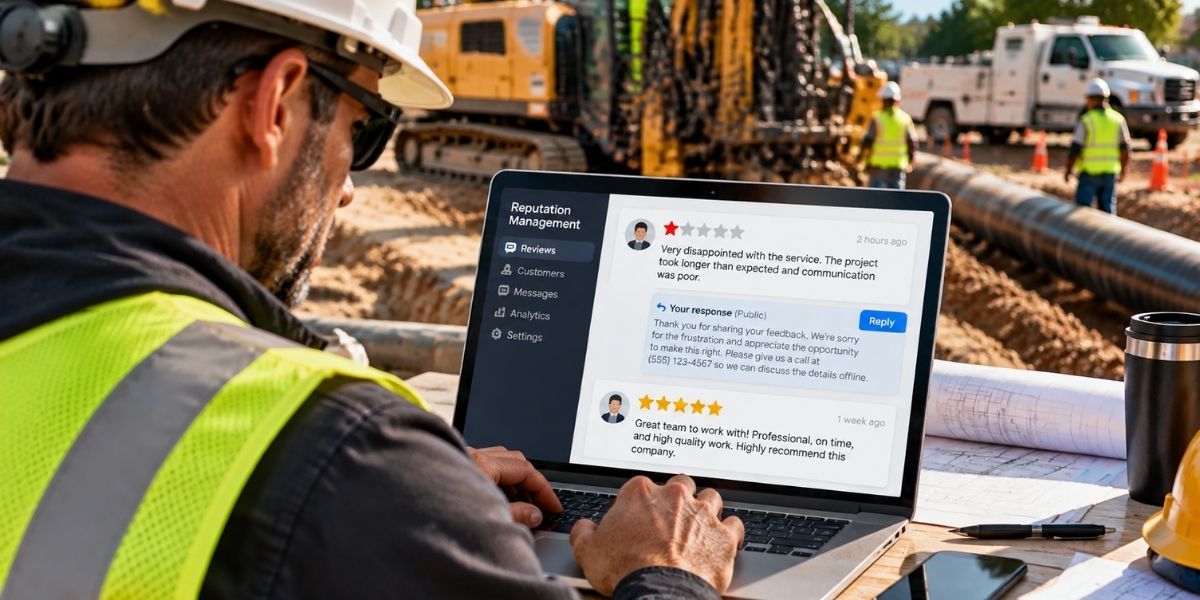
To handle a negative review, respond within 24 hours, stay calm, and never argue. Acknowledge the customer's experience, apologize for the frustration, and move the details offline with a phone number. You are not writing for the upset reviewer, you are writing for the next customer reading it. A calm, professional reply to a bad review often builds more trust than a page of five-star ratings.
Every contractor gets a bad review eventually, even the great ones. What separates the companies that lose work from the ones that keep growing is how they respond. This guide shows how to handle negative reviews the right way, deal with fake ones, and manage your reputation so a bad review can actually win you trust.
Why do negative reviews matter so much for contractors?
Because buyers check your reviews before they ever pick up the phone to call you. For a trade built almost entirely on trust, a single bad review sitting at the top of your profile can quietly cost you jobs you never even knew were possible.
The data is clear. BrightLocal found that 97% of consumers read online reviews before choosing a business, 89% expect owners to respond to reviews, and 80% are more likely to hire a company that replies to every review. Silence is now its own bad signal.
Here is the good news most contractors miss: buyers do not expect perfection. They expect you to handle problems well, and a calm reply to a negative review shows exactly that.
How fast should you respond to a negative review?
Within 24 hours. A quick, professional reply shows future customers you take feedback seriously, while a review left sitting for days makes it look like you do not care.
Speed is only rising in importance every year. In 2026, about 19% of consumers expect a same-day response to their review, up from just 6% a year earlier. Set up alerts so you see new reviews within hours, not days or weeks.
How should a contractor respond to a negative review?
Use the same simple formula every time, so emotion never runs the reply. Seven steps cover it:
What should you actually say? Response examples
The formula is easier to use with real examples. Here is how the same calm approach works across three common situations.
A valid complaint
Thank you for the feedback, and I am sorry your project did not go the way it should have. That is not the experience we want for anyone. Please call me directly at [number] so I can understand what happened and make it right.
A misunderstanding
Thanks for taking the time to share this. I want to make sure we are talking about the same job, because our records show a different timeline. I would like to sort this out with you directly, so please reach me at [number].
A job you do not recognize
We take every review seriously, but we have no record of working with you. If this was our company, please contact us at [number] so we can look into it. If it was meant for another business, we would appreciate you updating the review.
Notice that none of these argue, blame, or beg. Each one stays calm, sounds human, and moves the conversation off the public page.
What should you never do in a review response?
The wrong reply does more damage than the review itself. A few moves turn a small problem into a public fight:
- Arguing or getting defensive in public.
- Calling the reviewer a liar, even if they are wrong.
- Sharing private job or payment details to prove a point.
- Writing a long, emotional wall of text.
- Ignoring it and hoping it disappears.
Remember who is really reading. The next ten customers will judge you by your tone, not by the complaint.
Can you remove a negative or fake review?
Only if it breaks the platform's rules. You cannot delete a genuine bad review just because you disagree with it, but you can flag reviews that violate policy, like spam, hate speech, or a review left by someone who was never a customer.
Fake and competitor reviews are common in the trades. Flag them through your Google Business Profile, select the reason they break policy, and be patient, since removal can take time and is not guaranteed. While you wait, a calm public reply noting you have no record of the job protects you with future readers.
What if you keep getting the same complaint?
Then the reviews are trying to tell you something useful. If several different people mention the same issue, like messy job sites or poor communication, that is an operations problem, not a marketing one.
Treat repeated negatives as free consulting. Fix the root cause, and your ratings climb on their own. The best contractors use review patterns as a quality-control tool, not just a scoreboard.
How do you outweigh a bad review over time?
You cannot erase most bad reviews, but you can bury them under recent good ones. When a rare one-star sits among dozens of fresh five-stars, buyers read it as the exception, not the rule.
The fix is a steady flow of new reviews from happy customers, which also helps your ranking since Google favors recent activity. A strong, active profile paired with your local SEO and steady search visibility work keeps positive, up-to-date reviews at the top where they do the most good.
Reputation is bigger than reviews
Reviews are the loudest part of your reputation, but not the only part. Buyers also judge you by your website, your social pages, and how you show up everywhere they look.
Keep it all consistent and professional. Your social media presence and a credible contractor website should back up your reviews, and the tips in our guide to the best social platforms for contractors help you keep those channels active. The proof in our case studies then shows the kind of track record that makes an occasional bad review easy to shrug off.
Strong reviews also feed the rest of your marketing. They build the trust that turns visits into calls, which is the whole point of getting more contractor leads in the first place, and they fit inside the wider plan in our guide to digital marketing for construction companies.
How do you set up a system to catch reviews fast?
You cannot respond quickly to reviews you never see. The contractors who handle reviews well have a simple system, not a marketing degree.
Turn on notifications so a new review reaches you within hours. Then decide who on your team is the first responder, and give them the response formula so replies stay calm and consistent even when you are on a job site.
Put the process in writing: who checks each platform, how often, and how to reply. A one-page playbook means a bad review never sits for a week just because everyone assumed someone else would handle it.
Should you use review management software?
For a small contractor, you can do all of this by hand at first, and many do. A saved reply template and phone alerts will beat most competitors, who never respond at all.
As you grow across more platforms and locations, review software can watch every site, alert you instantly, and help you request new reviews automatically. Start manual, and add tools only when the volume makes them worth it, not before.
What reputation mistakes do contractors make?
A few habits quietly damage an otherwise good reputation. Watch for these:
- Not monitoring reviews, so bad ones sit unanswered.
- Responding only to the negatives, never the positives.
- Getting emotional or defensive in public replies.
- Letting positive reviews go stale for months.
- Treating repeated complaints as bad luck instead of a fixable problem.
Avoid these and your reputation becomes a steady source of new work.
Frequently asked questions
How should a contractor respond to a negative review?
Respond within 24 hours, stay calm, acknowledge the experience, apologize for the frustration, and take the details offline with a phone number. Never argue or blame the reviewer.
Can you remove a fake or negative Google review?
Only if it breaks Google's policies. You can flag spam, abusive, or non-customer reviews through your Google Business Profile, but genuine bad reviews cannot simply be deleted.
Do negative reviews hurt your business?
A single well-handled negative review rarely hurts, and can build trust. Damage comes from ignoring reviews or replying badly, not from the occasional complaint itself.
How fast should you respond to a review?
Within 24 hours for negatives, and sooner if you can. Nearly one in five consumers now expects a same-day response, so fast replies matter more every year.
Should you respond to positive reviews too?
Yes. Most consumers are more likely to hire a business that replies to every review, so thank happy customers by name and reference their job.
A bad review feels personal, but to future customers it is just a test of how you handle problems. Respond fast, stay calm, take it offline, and keep good reviews flowing. Do that, and the occasional negative review becomes proof that you are a contractor worth trusting. If you would rather have a team watch and manage it all for you, our contractor marketing specialists work only with trenchless and utility contractors.
Want this handled for you?
We do this for trenchless contractors every day. Book a free strategy call and we will map a plan for your market.