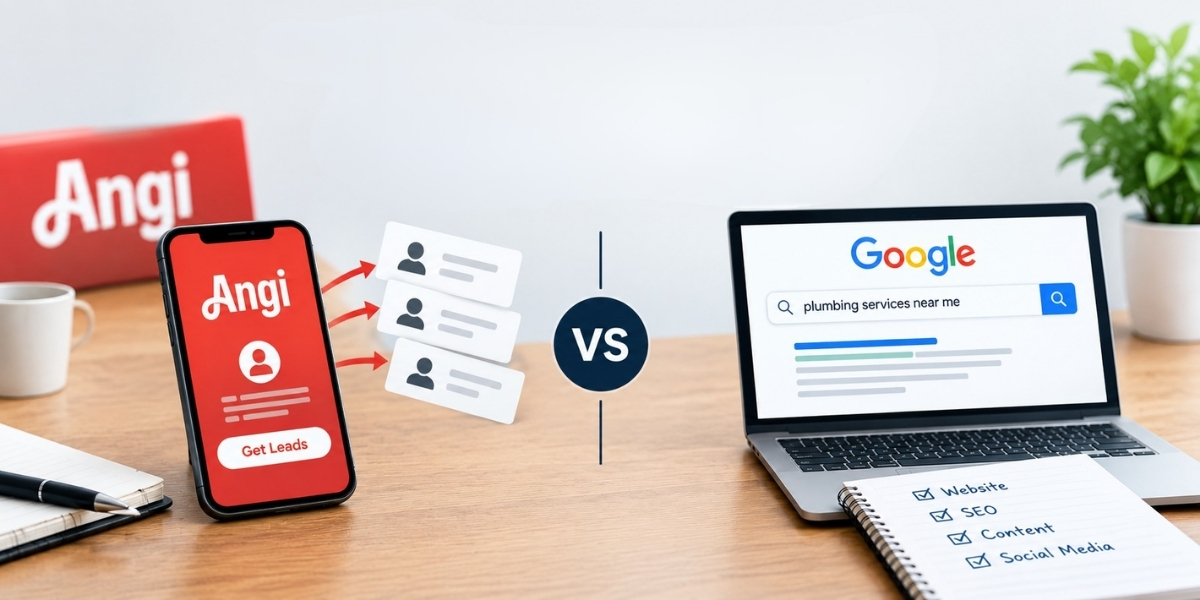
For most contractors, Angi leads are not worth it long term. The same lead is sold to three to eight competitors, close rates run about 10% to 20%, and the real cost per booked job often passes $1,000 once fees and dead leads are counted. Buying leads can fill an empty calendar fast, but you are renting customers. Generating your own leads through search and your website costs less over time and builds an asset you own.
If an Angi salesperson has been calling you, you have probably asked yourself the same thing every contractor does: are these leads actually worth the money? The honest answer is, it depends, but usually not for long. This guide breaks down what Angi leads really cost, why shared leads are the catch, and whether buying leads or generating your own wins.
What are Angi leads, and how do they work?
Angi, once known as Angie's List, is a large marketplace that connects homeowners with contractors. You pay to receive customer inquiries in your trade and area.
The model has two costs. You pay a yearly membership fee to be on the platform, then you pay again for each lead that matches your criteria. You are charged for that lead whether or not it ever turns into a paying job.
How much do Angi leads cost in 2026?
More than the sticker price suggests. Most contractors pay a membership fee of around $300 a year, plus roughly $15 to $120 per lead depending on the trade, with monthly spend commonly running from $300 to $2,500 or more.
The number that matters is not cost per lead, it is cost per booked job. Because leads are shared and close rates are low, the real cost to win one customer often climbs past $1,000, and in competitive markets it can reach $1,400 or more.
Why are shared leads the biggest problem?
Because you are rarely the only one who paid for that customer. The same inquiry is often sold to three to eight contractors at once, so the homeowner is flooded with calls the moment they hit send.
This creates a race in two directions. A race to call first, since whoever responds fastest usually wins, and a race to the bottom on price, since the homeowner is now comparing several bids. You still pay for the lead even if they never answer your call.
Are Angi leads worth it? The honest answer
For a few contractors, yes. For most, no, at least not as a long-term plan. It comes down to your close rate, your average job value, and how fast you answer the phone.
Angi can work if you have a strong sales process and can turn a high share of shared leads into real jobs. But if you are paying for leads that go to five other companies and picking up thin, price-shopped work, the math usually turns negative once you count your own time chasing dead leads.
When can buying contractor leads make sense?
Buying leads is not always a mistake. It has a real place, mostly early on or when you need work fast.
- You are brand new and have no online presence yet.
- Your calendar is empty and you need jobs this week.
- You answer the phone within minutes, every time.
- You have a high close rate and a fast, tight sales process.
If that sounds like you, buying leads can bridge a gap. Just treat it as a short-term boost, not the foundation of your business.
When should you walk away from Angi?
Walk away when the numbers stop working. For many contractors, that point comes fast.
- Your average job is small and your margins are thin.
- You cannot answer every lead within a few minutes.
- You are paying for leads you already generate yourself.
- You are locked into a contract with a steep cancellation fee.
The last one stings most. Paying Angi for a lead that also found you on Google means you are paying twice for the same customer.
Buying leads vs generating your own: renting vs owning
This is the real choice, and it is simpler than it sounds. Buying leads is renting. Generating your own is owning.
When you buy leads, the customers stop the day you stop paying, and you never control the platform, the price, or the competition. When you generate your own leads through search and your website, every lead is yours alone, and the work compounds. Rankings you build this year keep bringing calls next year, at a lower cost each month.
| Buying (Angi) | Generating Your Own |
|---|---|
| Lead is shared with 3-8 rivals | Every lead is exclusively yours |
| Stops the day you stop paying | Keeps producing for years |
| Race to the bottom on price | You compete on trust, not price |
| No control over the platform | You own the website and profile |
| Rising fees and contracts | Costs drop as rankings grow |
| Renting your pipeline | Owning your pipeline |
This is exactly the trade-off we walk clients through in our guide on how to generate more contractor leads, where owning your pipeline almost always wins over renting it.
What does generating your own leads look like?
It is not one magic tactic. It is a handful of owned channels that feed each other and get cheaper over time:
- Rank on Google for your services with SEO.
- Run ads that send exclusive calls straight to you.
- Keep a complete, active Google Business Profile.
- Use a website built to turn visitors into calls.
- Collect steady reviews to build local trust.
Search is the anchor. Strong trenchless SEO brings in buyers who are already looking for your service, and the groundwork in our local search checklist helps you show up across your service area, with no per-lead fee.
What are the best alternatives to Angi?
The best alternative is any channel where the lead belongs to you. Three stand out for contractors.
First, exclusive paid ads. Unlike shared Angi leads, Google Ads for contractors send the call directly to you, and our comparison of SEO versus paid ads shows how to balance the two.
Second, your Google Business Profile, which brings free local leads once it is set up well. Third, a website that turns visitors into calls, so every lead you earn actually converts instead of leaking away.
How does Angi compare to Google Local Services Ads?
This is the comparison most Angi salespeople will not walk you through. Both charge per lead, but the leads are very different.
Angi leads are shared, so a handful of contractors chase the same homeowner and close rates sit around 10% to 20%. Google Local Services Ads send exclusive leads that call you directly, and exclusive leads book at a far higher rate, often around 44%. Even at a similar price per lead, exclusive leads cost far less per booked job.
Angi has also faced trust problems, including a $7.2 million settlement with the FTC in 2023 over claims about lead quality and sources. That history is worth weighing before you sign an annual contract.
Why does owning your leads matter more over time?
Because bought leads never build anything. You pay, you get a lead, and the moment you stop paying, the leads stop cold. You are left with nothing to show for the spend.
Owned channels work the opposite way. Every review, ranking, and page you build stays yours and keeps producing. A year of steady SEO and reviews often brings in leads at a fraction of the cost of a shared lead, and that gap widens every year you keep at it.
What mistakes do contractors make with lead-buying?
A few habits make bought leads even more expensive than they look. Watch for these:
- Treating shared leads as a long-term strategy instead of a short-term boost.
- Not answering within minutes, so you pay for leads you never reach.
- Ignoring cost per booked job and watching only cost per lead.
- Paying for lead platforms while your own website and profile sit neglected.
- Signing a long contract with a heavy cancellation fee before testing results.
Avoid these, and you will spend far less to win the same work.
Frequently asked questions
Are Angi leads worth it for contractors?
Usually not long term. Leads are shared with three to eight contractors, close rates run about 10% to 20%, and the real cost per booked job often passes $1,000. It can help a brand-new business fill a gap.
How much do Angi leads cost?
Around $300 a year for membership, plus roughly $15 to $120 per lead by trade. Monthly spend commonly runs $300 to $2,500 or more, and the true cost per won job is much higher.
Are Angi leads shared or exclusive?
Most are shared. The same inquiry is typically sold to three to eight contractors, so you compete on speed and price for every lead you pay for.
What is the best alternative to buying leads?
Generating your own through SEO, exclusive ads, a strong Google Business Profile, and a website that converts. These leads are exclusive and cost less over time.
Is it better to buy leads or generate your own?
Generating your own almost always wins long term. Bought leads stop when you stop paying, while owned channels keep producing and get cheaper as they grow.
Buying leads is renting; generating your own is owning. If you would rather build a pipeline you control, our guide to digital marketing for construction companies lays out the plan, the results in our case studies show what it produces, and our trenchless and utility marketing specialists work only with contractors in these trades.
Want this handled for you?
We do this for trenchless contractors every day. Book a free strategy call and we will map a plan for your market.