Telecom buildout contracts go to fiber contractors who can prove they are qualified, bondable, and ready to produce footage on schedule. Landing that work means getting prequalified with carriers and primes, signing master service agreements, and showing a safety and production record that lowers the buyer's risk.
This guide breaks down how those contracts are actually awarded, and the steps a fiber crew can take to win more of them. The language is plain, and the focus is practical, so you can act on it this week.
Who awards telecom buildout contracts?
Fiber buildout work comes from a few types of buyers, and knowing which one you are chasing changes how you pitch. The money usually starts with national and regional carriers, internet providers, and cities building their own broadband networks.
Those groups rarely swing every shovel themselves. They hire prime contractors and engineering firms, who then subcontract the boring, plowing, and splicing to fiber crews like yours.
A lot of today's work is also funded by federal and state broadband programs aimed at reaching rural and underserved areas. That funding is pushing a wave of new buildouts, and contractors who track the procurement portals and bid boards can position for it early.
It pays to learn which carriers and primes are active in your region. A relationship with one busy prime can feed a crew for years, long after any single project ends.
What does a telecom buildout job involve?
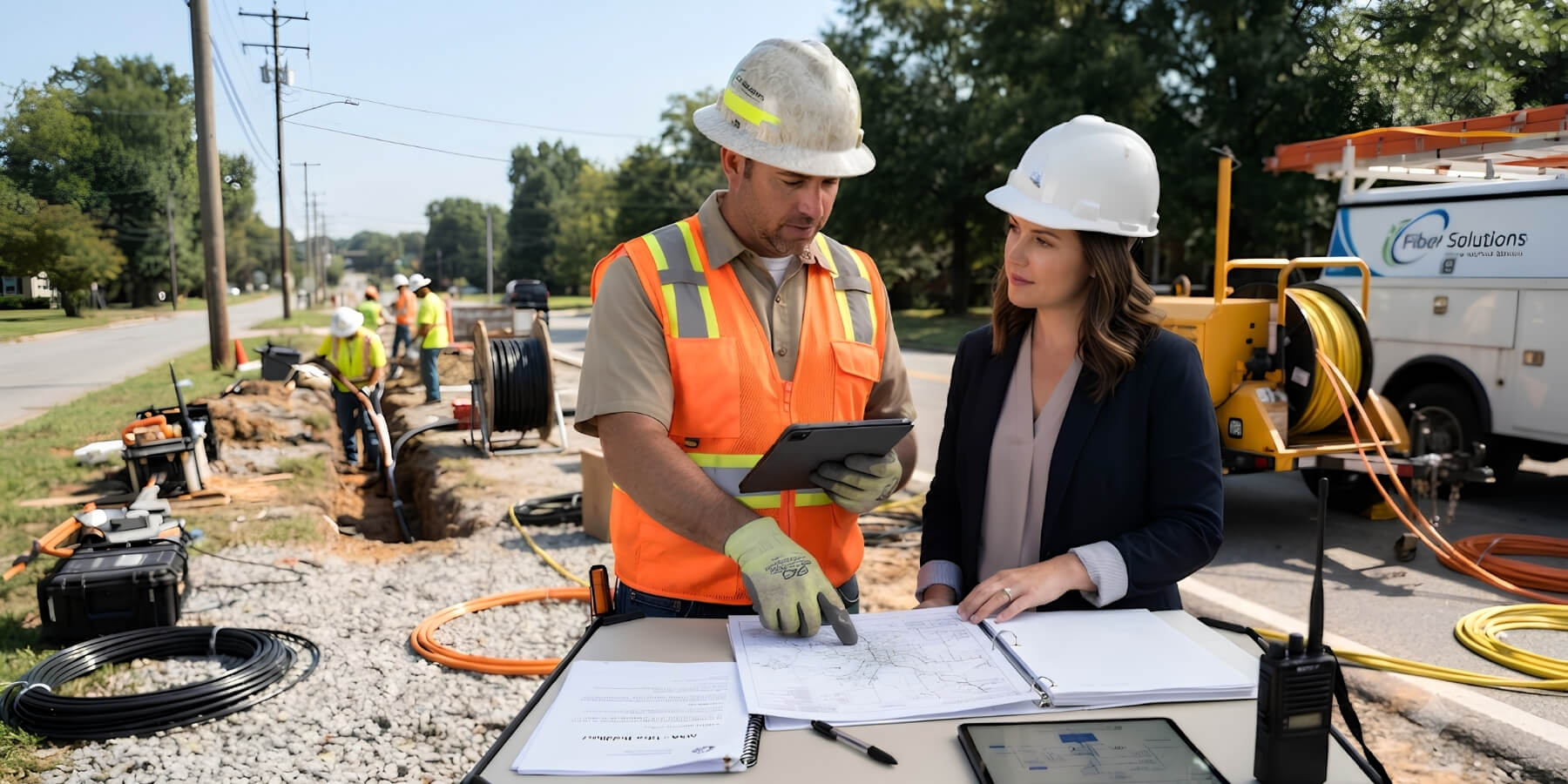
A buildout is more than pulling cable. Depending on the route, your crew may bore under roads, plow fiber through open ground, hang aerial lines, set handholes, splice, and restore the surface behind you.
Buyers want a sub who understands the whole scope, not just one piece. A crew that can handle boring, conduit installation, placement, and splicing, and coordinate traffic control and permits, is easier to hand a full segment to.
That range is also how you grow. The more of the job you can cover well, the larger the assignments a prime will trust you with.
What do telecom buyers look for in a fiber contractor?
Before anyone hands you footage, they check whether you are a safe bet. Telecom buyers and primes screen fiber subs on a short list of things, and missing any one of them can knock you out early.
- Prequalification paperwork and proof of financial stability.
- Bonding capacity that matches the size of the job.
- A clean safety record, including your EMR and OSHA history.
- Crew and equipment capacity, measured in footage per week.
- Relevant past projects with references who will vouch for you.
- Proper licensing, insurance, and utility or DOT compliance.
The contractors who win keep these documents current and ready to send the same day. When a prime needs a sub fast, the crew with a complete package gets the call, not the one still hunting for its insurance certificate.
How do you get prequalified and land a master service agreement?
Most steady fiber work runs through a master service agreement, or MSA. An MSA puts you on a carrier's or prime's approved vendor list, so you can be assigned jobs without bidding each one from scratch.
Getting there takes a prequalification package: your insurance, bonding, safety program, licenses, and past-project references, all organized and easy to read. Submit it the way each buyer asks, and keep a copy ready to update.
Relationships matter as much as paperwork. Introduce yourself to the procurement and construction managers who assign work, and stay in touch. Many crews break in by starting as a sub to an established prime, delivering clean, and earning bigger assignments over time.
Treat that first subcontract as an audition. Clean work, honest updates, and an on-time finish are what turn a one-off into a standing agreement.
How do you win the actual bid or RFP?
When a job goes out for bid, the request for proposal spells out the scope, the footage, and how pricing works. Read it closely, because a strong bid answers exactly what the buyer asked, not what you assumed.
Price your units realistically and back your schedule with the crew and equipment to hit it. Buyers have been burned by low bids that stall, so a believable timeline can beat a cheaper one. Show your math where you can, so the buyer sees a bid grounded in real production rates rather than a guess.
For large or complex buildouts, teaming with a prime or a fellow contractor can make you competitive on work you could not carry alone. A clear, organized proposal with proof of past production does the rest.
How do you build a record that unlocks bigger contracts?
Early on, take the jobs you can deliver cleanly, even the smaller ones. Each finished project becomes proof you can hand the next buyer.
Document everything as you go: footage completed, on-time finishes, safety stats, and photos of the work. Ask happy project managers for references while the job is fresh in their minds.
Over time, that record becomes your strongest sales tool. Production numbers and a clean safety history tell a bigger carrier you can be trusted with a bigger scope. Keep those numbers where you can pull them fast, because the crew that answers a prime's question the same day usually stays top of mind.
How does your online presence help you land contracts?
Telecom work is B2B, but the people vetting you still start on Google. A procurement manager checking a new sub will look up your website, your past projects, and your reviews before they call, so it pays to fix the website mistakes that quietly lose bids.
A clear site that shows your fiber experience, completed footage, certifications, and service area helps them vet you in minutes. If a prime is searching for a fiber crew in your region, you want to be the company they find first. Our fiber optic contractor marketing is built to make that happen. Trenchless Marketing Agency works only with underground and telecom crews.
That visibility does not replace relationships or paperwork, but it supports them. It tells a serious buyer you are established, active, and worth a conversation. If you decide to bring in outside help, our guide on choosing a marketing agency is a good place to start.
Which mistakes cost fiber contractors these contracts?
A few missteps quietly push crews to the bottom of the list. Watch for these:
- Sending an incomplete or out-of-date prequalification package.
- Underbidding, then falling behind schedule once the work starts.
- Weak safety numbers that fail a prime's screening.
- Going quiet after one job instead of staying in front of the buyer.
- No online presence, so a procurement manager cannot confirm who you are.
Fix these and you look like a lower-risk pick than most of the field, which is exactly what a buyer is hoping to find.
Frequently asked questions
What is a master service agreement in telecom fiber?
It is a standing contract that places you on a buyer's approved vendor list. Once it is signed, you can be assigned jobs without bidding each one separately.
Do I need bonding to win telecom buildout work?
Usually, yes. Most carriers and primes require bonding that matches the job size, so building your bonding capacity early opens more doors.
Should I go after work as a prime or a subcontractor?
Most fiber crews start as subs to build a record and steady cash flow, then take on prime roles as their bonding and team grow. There is real money in both.
What is broadband funding, and why does it matter?
Large federal and state programs are paying to expand internet access into rural and underserved areas. That money is driving new fiber buildouts, and contractors who track it can line up work sooner.
How long does it take to get on a carrier's vendor list?
It varies, often weeks to a few months, depending on how complete your package is. Keeping your documents current and following up speeds it up.
Want this handled for you?
We do this for trenchless contractors every day. Book a free strategy call and we will map a plan for your market.